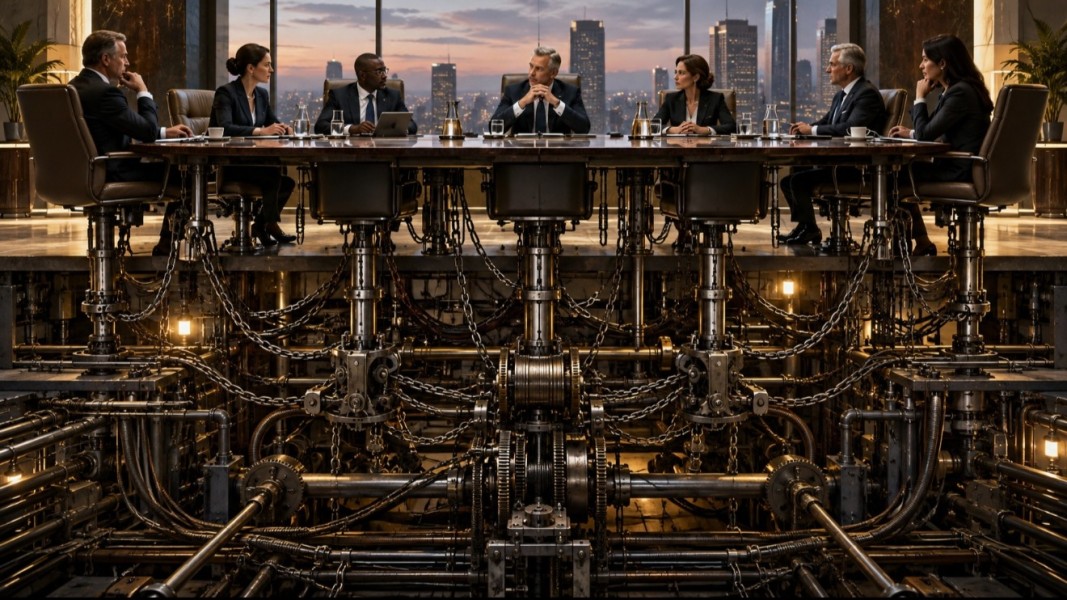
There are moments when an organization becomes so incoherent that it begins, involuntarily, to reveal itself.
The grotesque makes reality visible through distortion.
In organizations, this happens more often than we are willing to admit.
We have simply learned to call it other things.
Governance. Coordination. Alignment. Transformation. Change management. Agility.
Perfectly reasonable words that, in some organizations, end up describing precisely the opposite of what is happening.
A company wants to speed up decisions.
It creates a new committee.
The committee introduces an escalation process.
The process requires a preliminary meeting.
The preliminary meeting produces a document.
The document must be validated before someone can finally make the decision that was supposed to be accelerated in the first place.
It is grotesque.
Above all, however, it is revealing.
Because that sequence tells us something an organizational chart is unlikely to show: in that organization, no one wants to assume the full risk of deciding.
The system, therefore, is not designed to make better decisions.
It is designed to distribute responsibility.
The difference is enormous.
Organizations reveal far more through their contradictions
A company declares that it wants to become agile.
Then it requires seven approvals to change a procedure.
Another says it wants to develop entrepreneurial leadership.
Yet it systematically penalizes anyone who makes a decision not provided for in the budget.
A CEO demands greater accountability from management.
Then personally intervenes in operational decisions whenever the outcome fails to match expectations.
An organization proclaims that it wants people capable of dissent.
Then builds careers around those who have learned exactly when it is best not to.
These situations differ only on the surface.
They all have something in common.
The gap between the declared organization and the real one has become large enough to be visible.
That is where the grotesque emerges.
Not when a process works poorly or a structure is inefficient.
But when the organization continues to claim it is pursuing an objective while its own system of power, incentives and behaviours systematically produces the opposite result.
That is precisely what makes it interesting.
Distortion makes observable what would normally remain hidden.
Take transformation
Few words have been used as much as “transformation”.
And few have been neutralized as effectively.
Some companies have built Transformation Offices, appointed Chief Transformation Officers, and defined roadmaps, milestones, steering committees, dashboards and multi-year programmes.
Yet they continue to function essentially as before.
Not necessarily because people have done their jobs badly.
But because the organization has transformed everything except what actually determined how it worked:
decision rights, the distribution of power, resource allocation, incentives, entrenched organizational privileges, and the ability to block a decision without being accountable for the consequences.
At that point, something almost perfect in its absurdity happens.
Transformation becomes a function tasked with managing the impossibility of transforming the company.
And there it is again.
The grotesque.
Not as an exception.
As an X-ray.
The same happens with data
Many organizations have responded to complexity by increasing the amount of information available.
Dashboards. KPIs. Scorecards. Reports. Analytics. Business intelligence.
The result should be greater decision-making capability.
Sometimes the opposite happens.
Every function has its own numbers.
Every number has a different definition.
Every meeting begins with a discussion about which figures are correct.
And by the time agreement is finally reached on how to represent the problem, the problem has already changed.
The point is not to mock excessive reporting.
The point is to understand what it reveals.
Often, the overproduction of data does not stem from a desire to understand the company better.
It stems from the difficulty of establishing who has the authority to define what matters.
When there is no clear hierarchy of priorities, indicators proliferate.
When there is no decision, analyses proliferate.
When there is no accountability, metrics proliferate.
Informational complexity thus becomes a substitute for making a choice.
The grotesque is an indicator of power
This is perhaps the most important part.
Organizations are usually analysed through structures, processes, roles and results.
There is another way to read them.
Observe their absurdities.
Ask why evidently irrational behaviour continues to survive.
Why does a consistently unprofitable client remain untouchable?
Why does a meeting everyone considers pointless continue to consume fifty hours of management time every month?
Why is a process that no one openly defends never eliminated?
Why does a manager regarded as inadequate for years remain in the role?
Why does an organizational layer that slows every decision continue to exist?
The answer is rarely: because no one has noticed.
Very often, everyone has noticed.
The problem lies elsewhere.
That absurdity protects something.
Power. Relationships. Entrenched privileges. Responsibilities no one wants to assume. Conflicts senior leadership would rather not confront.
And this is where the grotesque definitively stops being amusing.
Because behind many apparently incomprehensible inefficiencies lies a perfectly understandable logic.
It is simply not the logic of the business.
It is the logic of the system of power that has formed within it.
This is why anomalies should not be corrected too quickly
When I enter an organization, its contradictions interest me more than its best practices.
An absurd process.
A duplicate approval.
A pointless meeting.
A KPI no one uses.
A decision that keeps returning to the table.
A formally important role that everyone bypasses.
They are anomalies only on the surface.
Before eliminating them, we need to understand them.
Because they often serve a function.
Perhaps not the declared one.
But a real function nonetheless.
And if we address the symptom without understanding what it protects, the organization will quickly recreate the same mechanism somewhere else.
The process will change.
The system will not.
This is one of the most frequent mistakes in organizational transformation: correcting what appears inefficient without asking why that inefficiency has managed to survive.
Companies do not become grotesque overnight
They get there slowly.
A small exception becomes a procedure.
The procedure generates a control.
The control generates a function.
The function produces reporting.
Reporting requires coordination.
Coordination produces a committee.
And after a few years, no one remembers which original problem they were trying to solve.
But everyone defends the piece of the system that has, in the meantime, become part of their role.
This is how complexity stops being a response to reality.
And becomes a reality in its own right.
At that point, the company may even function.
It may grow.
It may deliver results.
That is precisely what makes the phenomenon dangerous.
Because organizations rarely change when something is plainly broken.
They find it much harder to change when something continues to work well enough to allow everything that does not work to survive.
That is where we should look.
Not only at the results.
But at the contradictions those results are financing.
Perhaps, then, we should add a question to those normally used to read an organization.
Not only:
Where are we losing efficiency?
Where are decisions slowing down?
Where do we need to simplify?
But also:
Where have we become grotesque?
Because that may be precisely where the most faithful representation of the company can be found.
The point where declared strategy, formal structure and actual behaviour collide.
The point where organizational rhetoric can no longer conceal reality.
The point where the business, unintentionally, finally tells the truth about itself.
If you really want to understand an organization, do not look only at where it works.
Look at where it becomes grotesque.
That is where it stops telling its story.
And begins to show itself.
Andrea Scotti · COO & Enterprise Transformation Executive
Read the original Italian article on LinkedIn ↗